WhatsApp

Pulling Copper Back Out of Electronics Scrap
This is one of our own development programmes rather than a client engagement, which is why it can be described in full.
The challenge
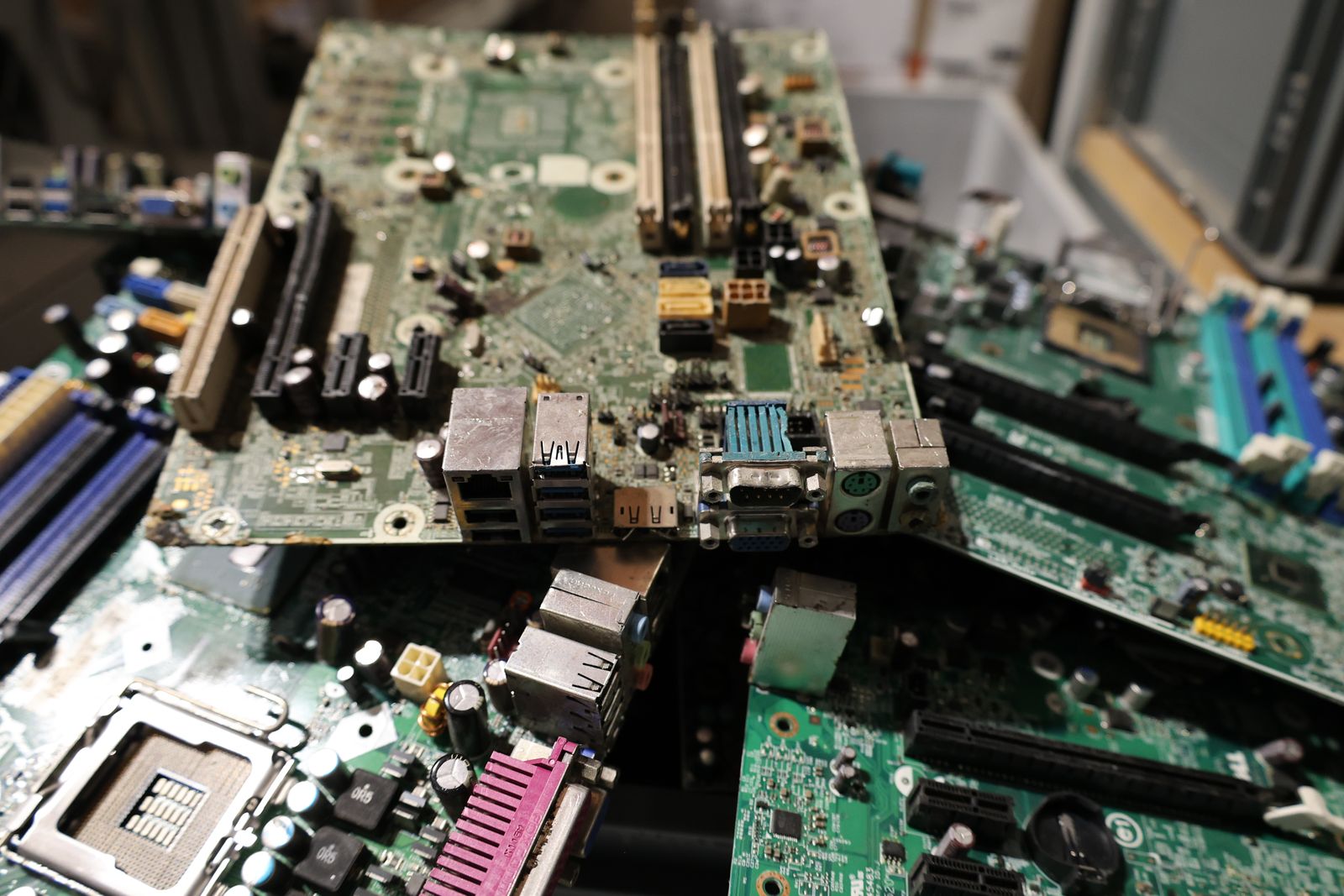
Electronics scrap is one of the richer copper sources available, richer by concentration than a good deal of mined ore. Boards, connectors, and wiring carry copper in quantity, and the volume arriving is not falling.
It is also, chemically, one of the least cooperative feeds you could design. The copper is not sitting in a clean matrix. It is bonded to glass-reinforced laminate, soldered to other metals, plated over or under nickel and tin, coated with organics, and mixed with the tin, lead, zinc, iron, and aluminium that the rest of the board is made from. Traces of precious metals are present too, in amounts that are worth attention and easy to lose.
So the difficult part is not extraction. Copper dissolves readily under the right conditions, and a first laboratory attempt will produce a blue solution within an afternoon and a good deal of premature optimism. The difficult part is that the same conditions dissolve much of what was next to it. What you have is not copper in solution. It is a mixed metal liquor from which copper now has to be separated, and that separation is the programme.
Characterise the feed before touching it
The first working rule we took from this: a recovered feed has to be characterised as carefully as a purchased raw material, because that is now what it is.
Scrap is heterogeneous in a way ore is not. Two consignments described identically can differ substantially in what they contain, because they came from different equipment, of different ages, built to different standards. A route developed on one drum and scaled on another is a route developed on the wrong thing.
Practically that means analysing each feed type for the metals actually present and at what level, and knowing which of those will follow copper through the chemistry. Our atomic absorption and elemental analysis capability does that work, and it is the least glamorous and most load-bearing stage of the whole programme.
The approach
Mechanical separation first, to the extent it is worth doing. Size reduction and physical sorting remove plastic, laminate, and much of the iron before any chemistry begins. Every kilogram of inert material removed here is a kilogram that does not consume reagent, occupy vessel volume, or complicate the filtration downstream. It is cheap and it is consistently underrated.
Dissolution second, under conditions chosen for what they leave behind as much as for what they take. Selectivity that can be built into the leach is selectivity that does not have to be recovered later at greater cost, and the temptation to run aggressive conditions for a fast, complete dissolution usually makes the rest of the process harder.
Selective recovery from the liquor third, and this is where the actual development time goes. Copper has to be brought out of a solution that also contains metals with overlapping behaviour, at a purity that makes the product saleable rather than merely present. Getting that wrong does not fail loudly. It produces copper contaminated at a level a buyer will reject, which is a worse outcome than not recovering it, because the cost has already been incurred.
Then the residue, which is not an afterthought. Whatever leaves the process still has to be a defined, compliant disposal item, and a recovery route that solves a metals problem by creating a liquid effluent problem has moved the cost rather than removed it.
Where the value leaks
Three places, consistently.
In the wash water. Every filtration and every rinse carries dissolved metal away with it. Individually small, collectively the difference between a viable recovery and a marginal one, and almost never accounted for in an early mass balance.
In the residue. Metal that never dissolved, or that co-precipitated where it was not wanted, leaves with the solids. A mass balance that closes on paper but has not been checked against the residue is usually hiding this.
In over-processing. Chasing the last few percent of recovery frequently costs more in reagent, energy, and cycle time than the material is worth. Knowing where to stop is a commercial decision informed by the chemistry, and it should be made deliberately rather than by exhaustion.
The outcome
The route is established and copper is recovered from electronics scrap as part of our waste-to-value work, alongside iron oxide pigments from iron waste, metals from lithium-ion black mass, and silica from rice husk.
No recovery percentage or tonnage is quoted here, deliberately. Recovery depends heavily on what a given consignment of scrap actually contains, and a figure achieved on one well-characterised feed, presented as though it were general, would set an expectation we could not honour on the next drum.
What the programme taught us
The pigment work taught us that recovery projects are specification projects. This one taught us the other half: they are separation projects.
The extraction step is where the attention naturally goes, and it is almost never where the difficulty is. In a mixed feed, the chemistry that dissolves your target dissolves its neighbours, and the programme is really about undoing that selectively enough to produce something a buyer will accept. Anyone scoping a recovery project on the strength of a successful leach has costed the easy half.
The second thing, which follows from it: the honest question at the start is not whether the metal can be recovered. It nearly always can. It is what purity the recovered material must reach to be worth something, and whether the separation to get there costs less than the metal is worth. That question is answerable early, on a characterised sample, for a fraction of what finding out later costs.
We design recovery technology as a service line. If you have a stream you are currently paying to dispose of, a feed analysis and an honest view on what the recovered material could be sold as is the right first step.
Written by
Dr. Babita A. Kale
R&D Manager
Dr. Kale directs the R&D team at ChemEngg Research, with project work running across metal recovery from lithium-ion battery black mass, iron oxide pigment synthesis, nanostructured silver and copper materials, and sodium-ion cathode development. She holds a Ph.D. in Chemistry from the University of Pune and spent eleven years teaching analytical chemistry before moving to industry. She is a certified lead auditor for both ISO 9001:2015 and ISO/IEC 17025:2017, which is what keeps laboratory practice and documentation aligned with the standards clients audit against.