WhatsApp

Scaling from Lab Bench to Pilot Demonstration
A reaction that behaves perfectly in a 250 millilitre flask can become unrecognisable in a fifty litre reactor. The molecules have not changed. The physics around them has.
Scale-up failures are rarely chemical failures. They are almost always failures of heat transfer, mixing, addition rate, or the assumption that something which took two minutes at the bench will take two minutes at scale. This piece covers what actually changes, and how to find out before you are committed.
Surface area does not keep up with volume
This single geometric fact causes more scale-up problems than everything else combined.
Scale a vessel up by a factor of a thousand in volume and its surface area increases by only a hundred. Heat generated by a reaction scales with volume; heat removed through the vessel wall scales with surface area. A mildly exothermic reaction that a round-bottom flask sheds into the room without anyone noticing has, at fifty litres, nowhere convenient to put that energy.
The consequences are practical. Cooling capacity becomes a rate limit rather than a background condition. Reagent addition that was "added dropwise over ten minutes" becomes an addition over three hours, controlled by how fast the jacket can remove heat. And an exotherm that runs away has considerably more material available to run away with.
Before any batch scales, we want to know the heat of reaction, the adiabatic temperature rise if cooling were lost, and whether anything decomposes at that temperature. If the answer to the last question is uncomfortable, the process needs redesigning rather than scheduling.
Mixing stops being instantaneous
At bench scale, a magnetic stirrer makes the contents of a flask effectively uniform. Add a reagent and it is everywhere at once.
In a fifty litre glass-lined reactor with an anchor agitator, it is not. There is a region near the addition point where the incoming reagent is at high local concentration for a real length of time, and there are corners where mixing is slow. For a reaction where the product can react further with the reagent, that local excess produces over-reaction products that never appeared at the bench. For a reaction with a competing pathway favoured at high concentration, the impurity profile shifts.
The usual fixes are unglamorous and effective: change where the addition enters, slow it down, dilute the feed, or change the agitator. The important part is recognising the cause. An impurity that appears only at scale is very often a mixing artefact rather than new chemistry.
Time at temperature gets longer, everywhere
A bench flask heats to 80 degrees in five minutes and cools in ten. A charged reactor may take an hour each way.
That means the material spends far longer in the warm-up and cool-down regions than it ever did in development. If your product degrades slowly at reaction temperature, a hold that was negligible at the bench becomes a measurable yield loss. If an intermediate is unstable, the extra hour before quench matters.
The same applies to workup. Filtration that took two minutes on a sinter can take four hours on a nutsche filter, with the wet cake sitting in mother liquor throughout. Crystallisations behave differently when cooling takes eight hours instead of twenty minutes, sometimes giving a different polymorph or a markedly different particle size.
Equipment stops being infinitely flexible
At the bench you can use whatever glassware suits the chemistry. At scale you use the reactor you have.
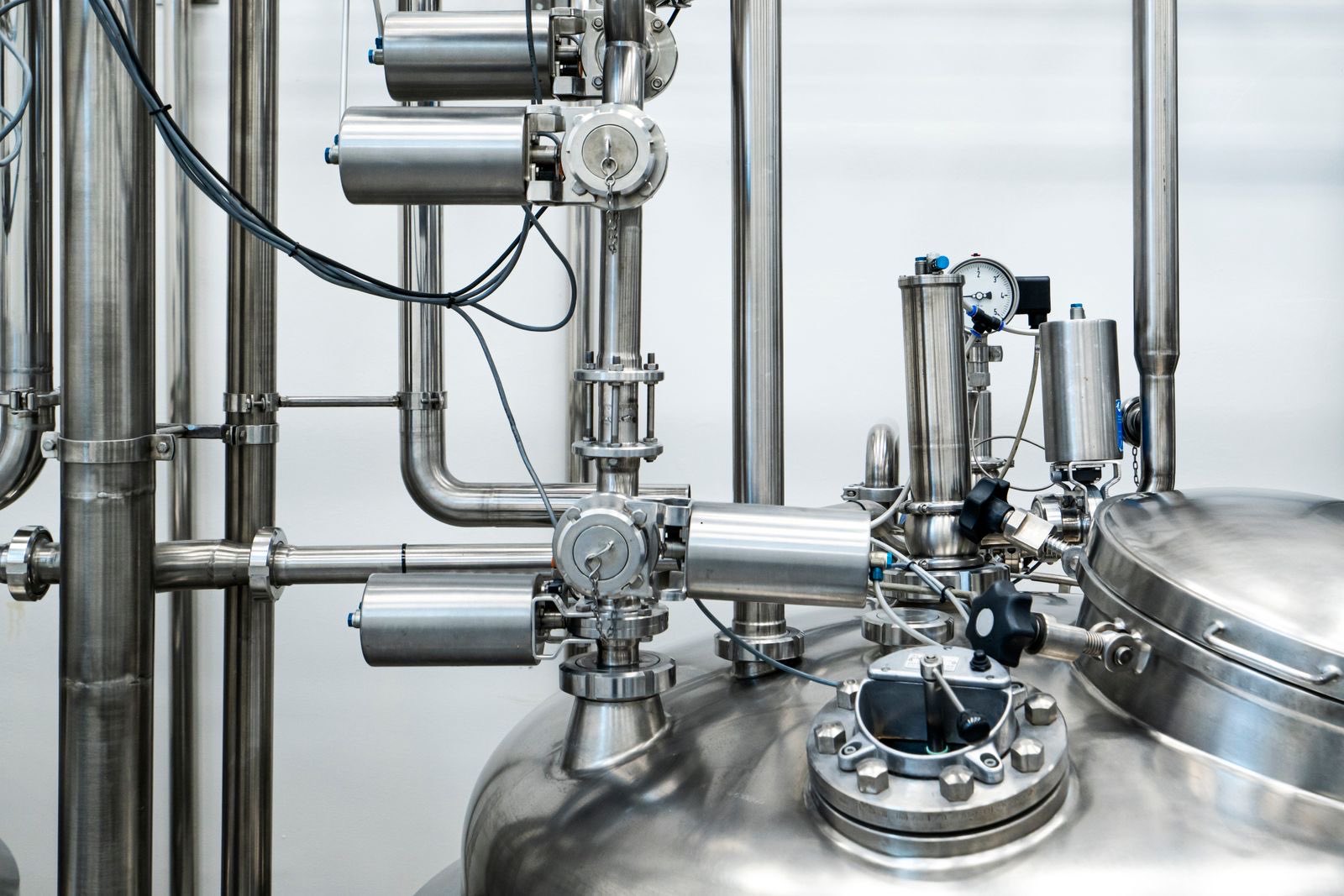
Our own pilot facility runs glass-lined reactors, a hydrogenation reactor, and the separation and drying equipment around them. That defines a real envelope: which materials of construction are acceptable, what temperature and pressure range is available, how the vessel is charged and discharged, and what can be cleaned out between campaigns.
A route that requires a solvent incompatible with the available seals, or a temperature below what the chiller reaches, is not a route at that plant regardless of how well it performs in a flask. It is much cheaper to learn this during route selection than after a campaign is scheduled.
Things that were trivial become significant
Several quantities that nobody tracks at the bench dominate at scale:
- Solvent volume. Cheap and invisible in a flask, a major cost in purchase, handling, recovery, and disposal at scale. Volume efficiency is worth optimising.
- Filtration and drying time. Frequently the true bottleneck in a campaign, not the reaction itself.
- Charging and discharging. Adding a solid to a flask takes seconds. Charging fifty kilograms of a fine powder into a reactor is a task with its own dust, static, and safety considerations.
- Cleaning between batches. A residue that rinses away with acetone in a flask may be genuinely difficult to remove from a reactor and its associated pipework.
Pilot scale exists to find these things
The purpose of a pilot batch is not to make material, though it usually does. It is to encounter every one of the problems above while they are still cheap.
A well-run pilot campaign produces a mass balance that closes, an impurity profile at real conditions, an actual cycle time including workup, a record of what went wrong and what was changed, and enough confidence to write a process description that someone else can follow.
If it also produces usable material, that is a bonus rather than the objective.
The practical sequence
Establish the constraints and thermal data. Choose a route the available equipment can actually run. Run the chemistry at the bench with scale-relevant addition rates and hold times rather than convenient ones. Take it to pilot expecting to find problems. Fix them there. Then write it down properly.
Most of the cost of a failed scale-up is not the failed batch. It is the schedule that was built on the assumption it would work.
We run this sequence on our own equipment in Pune, for our own products and for client programmes. If you have a route that works at the bench and you are unsure what it will do at fifty litres, that is a good conversation to have before the campaign is booked, not after.
Written by
Dr. Vaibhav R. Acham
Founder & Managing Director
Dr. Acham holds a Ph.D. in Chemistry with expertise in heterogeneous catalyst development and application, having researched at CSIR-National Chemical Laboratory in Pune and Humboldt University in Berlin. He brings over fifteen years of industrial R&D experience across specialty chemicals, pyridine chemistry, and food-safety analysis, spanning laboratory establishment, catalyst development, and process scale-up.