WhatsApp

Why a Crystallisation Stops Behaving at Scale
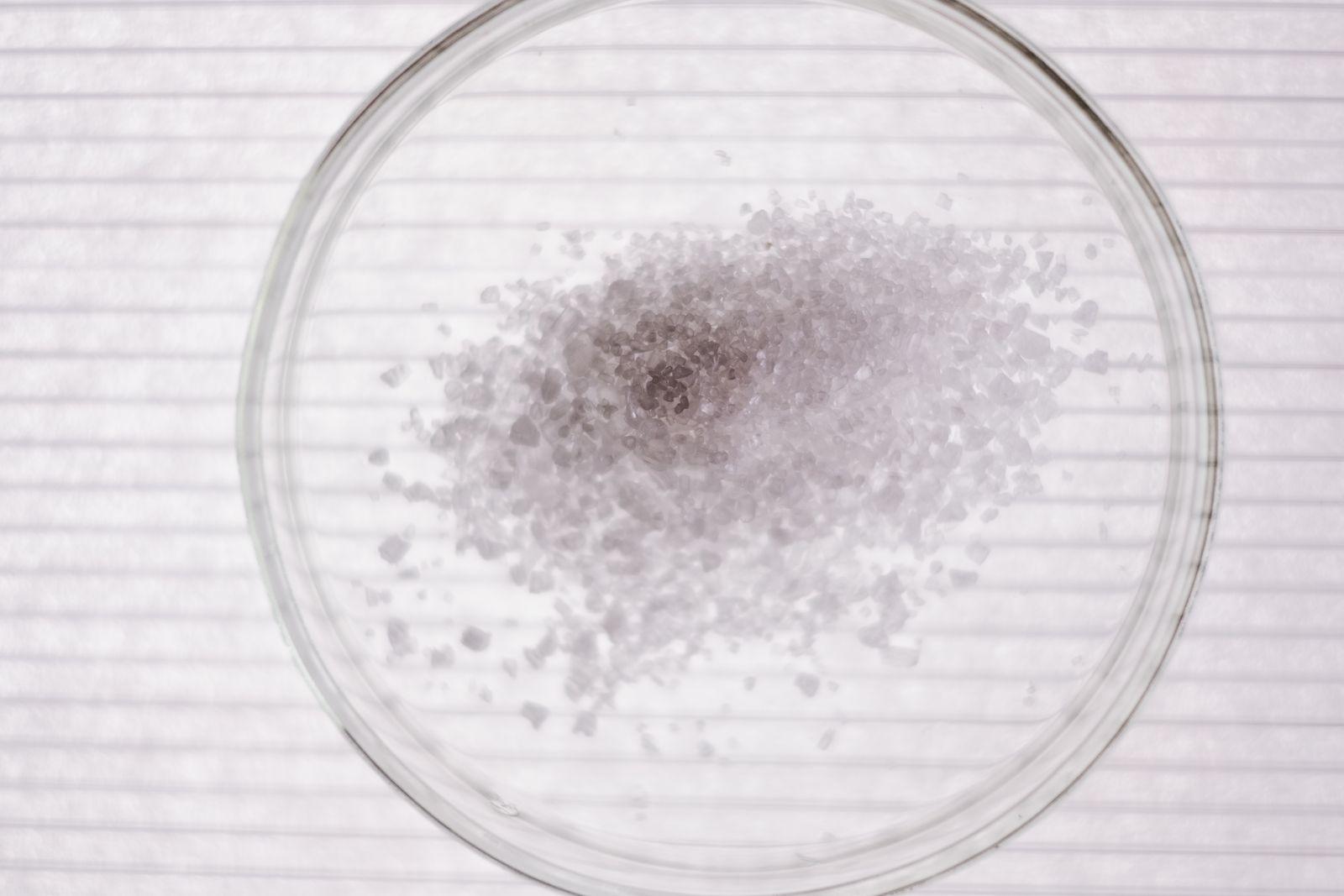
A crystallisation is the cheapest purification step available, and it is usually recorded in the laboratory notebook on a single line: cool, filter, dry. That line is where a great deal of scale-up trouble gets stored.
The chemistry does not change between a two litre flask and a five hundred litre reactor. Almost everything around the chemistry does, and a crystallisation is unusually sensitive to all of it.
Cooling is not a step, it is a profile
In a flask, taking a solution from eighty degrees Celsius down to twenty is a matter of switching off the mantle and waiting. The vessel is small, its surface area is large relative to its contents, and the solution follows the bath almost exactly.
A jacketed reactor holding several hundred litres does not behave that way. Heat has to leave through a fixed area of jacket, so the contents lag the jacket, the lag grows with batch size, and the temperature at the wall is not the temperature in the bulk. A cooling ramp that took forty minutes at the bench can take four hours at scale, and the supersaturation the crystals actually experience is different at every point along that curve.
Supersaturation is the variable that matters. It decides whether new crystals nucleate or existing ones grow, and the balance between the two sets the size of what you eventually filter. Cool quickly and you nucleate heavily, producing a great many small crystals. Cool slowly through the metastable zone and you grow the crystals already present. Both routes give a solid. Only one of them gives a solid you can handle.
Three things can change, and they are not the same problem
When a crystallisation misbehaves at scale the failure tends to get reported as a yield problem. It is more useful to separate it into three, because they have different causes and different fixes.
Polymorph is which crystal lattice the molecule adopts. A change here changes solubility, melting point, dissolution rate, and in a regulated context the identity of the material itself. It is driven by solvent, temperature, and the presence of seed. It is the least common of the three failures and by far the most expensive.
Habit is the shape a given lattice grows into: plates, needles, blocks. The lattice is unchanged, so a diffraction pattern looks correct while the material behaves entirely differently. Needles filter badly, hold mother liquor, and break under agitation. Habit is set largely by solvent and by the impurities present, which is why a change upstream can ruin a crystallisation that had been reliable for years.
Particle size distribution is the spread of crystal sizes. It follows from the nucleation and growth balance described above, and it is the property most directly under the control of the cooling profile and the seeding strategy.
A programme that reports only assay and yield will detect none of the three until the filter blinds.
Seeding is the control you already have
An unseeded crystallisation relies on spontaneous nucleation, which happens when it happens. The onset point moves with the vessel, the agitator, the surface finish, and the batch, so an unseeded process is reproducible only by luck.
Seeding replaces luck with a decision. Adding seed of the correct polymorph, at a known temperature inside the metastable zone, at a known loading, fixes both the form and the number of crystals that will grow. Everything after that is a growth process rather than a nucleation lottery.
The two mistakes are equally common. Seed too hot and the seed dissolves, returning you to spontaneous nucleation. Seed too cold and the solution has already nucleated on its own, leaving the seed as decoration.
Filtration rate is the number that decides the campaign
Yield is what gets reported. Filtration rate is what decides whether the campaign finishes on schedule.
A batch that filters in twenty minutes at the bench can take a full shift on a plant filter, and the reason is almost always crystal size and shape rather than anything about the chemistry. Fine crystals blind the cloth. Needles form a compressible cake that becomes less permeable the harder you pull on it. A cake that retains mother liquor carries impurities into the dried solid, where they appear as a purity failure that gets blamed on the reaction.
Washing follows the same physics. A well formed, free draining cake washes with a modest volume of solvent. A fine or needle-like cake channels, so the wash travels around the solid rather than through it, and the operator responds by using more solvent, which dissolves product and costs yield.
What to measure before the first pilot batch
The measurements that change a decision are these.
- The solubility curve in the actual crystallisation solvent, across the intended temperature range. Without it the cooling profile is guesswork and so is the theoretical yield.
- The metastable zone width, which tells you where seeding is possible and how much room the cooling profile has to work in.
- The polymorph present, by powder diffraction, on material from the bench batch. Establish which form you are making before arguing about whether you can control it.
- Habit, by microscopy. A photograph of the crystals costs an afternoon and predicts filtration behaviour better than any other single measurement.
- Particle size distribution, so that a change at scale is a measured change rather than a disagreement between two operators.
- Filtration and wash behaviour on a small filter, using the real slurry. A bench funnel is not a plant filter, but a slow bench filtration is a reliable warning.
Where this sits for us
Crystallisation and purification development sit inside our process development and custom synthesis work, and the sequence above is close to how we run it: solubility first, form second, cooling profile third, and filtration proved before anyone books a pilot campaign.
If you have a crystallisation that gave a clean, filterable solid in the laboratory and gives a slow, sticky one in the plant, the reaction is rarely at fault. The useful first experiment is to photograph the crystals from both batches and put the images side by side. It usually ends the discussion in an afternoon.
Written by

Dr. Vaibhav R. Acham
Founder & Managing Director
Dr. Acham holds a Ph.D. in Chemistry with expertise in heterogeneous catalyst development and application, having researched at CSIR-National Chemical Laboratory in Pune and Humboldt University in Berlin. He brings over fifteen years of industrial R&D experience across specialty chemicals, pyridine chemistry, and food-safety analysis, spanning laboratory establishment, catalyst development, and process scale-up.