WhatsApp

Keeping an Oxidiser Alive in a Recirculating Root Zone
This is an internal development programme rather than a client project, which is why we can set out both the reasoning and the limits of what we made.
The challenge
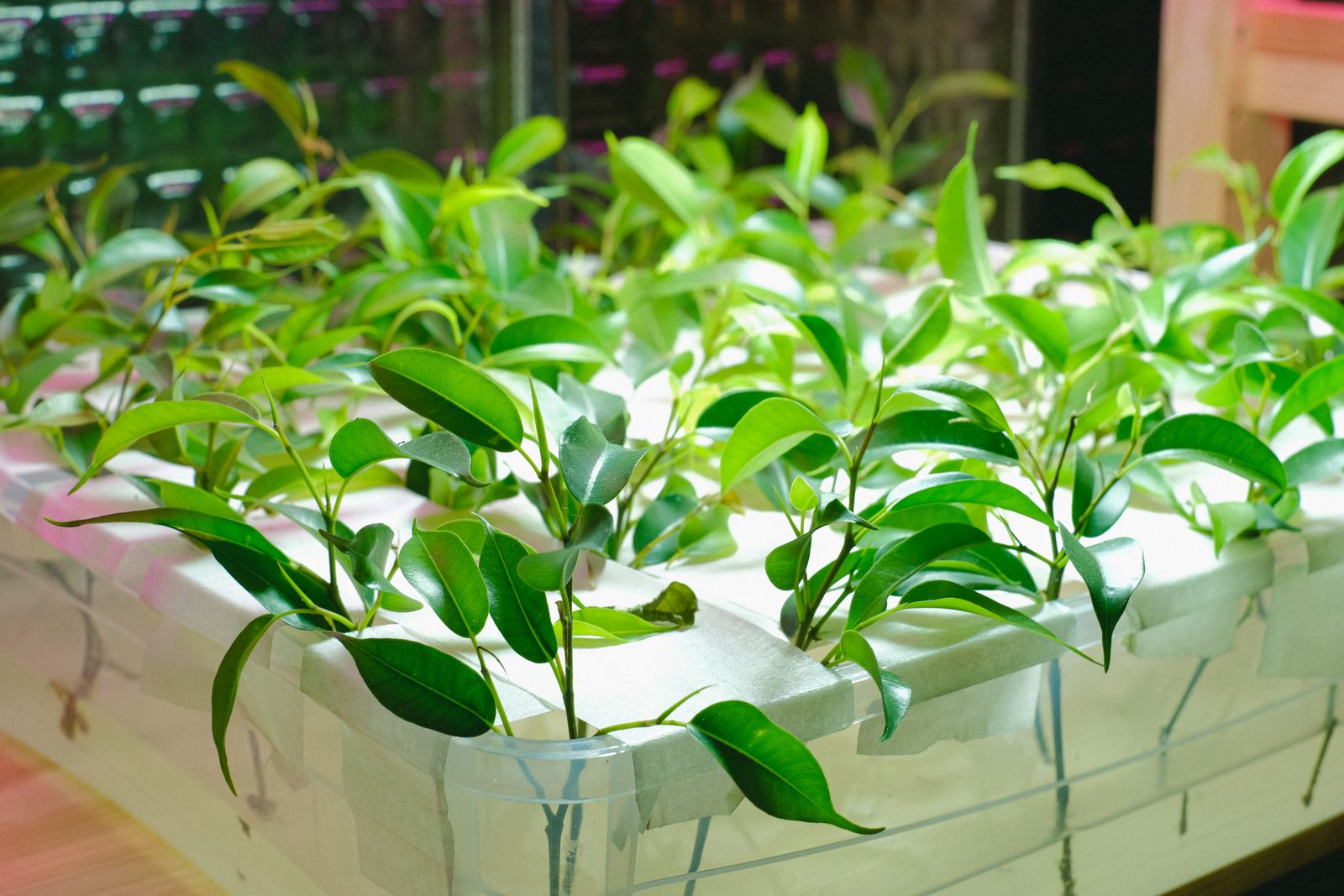
A recirculating hydroponic system has a water problem that a soil grower does not. The same nutrient solution passes the roots repeatedly, so any organism that establishes in it is delivered to every plant, continuously. Root pathogens and biofilm in the lines are not an occasional event in that setting; they are the default outcome unless something prevents them.
Hydrogen peroxide is an obvious candidate. It is a strong oxidiser, it is effective against the organisms that matter, and it degrades to water and oxygen, which means it leaves nothing behind that a residue limit or an organic certification would object to. For a grower selling into either of those markets, that decomposition is not a footnote. It is the entire reason peroxide is on the list at all.
The difficulty is that the same instability is what makes it fail. Peroxide decomposes readily, and it decomposes faster in exactly the conditions a nutrient circuit provides: warmth, light, dissolved metals from the nutrient salts, and organic load. Dose a system and a substantial part of the oxidiser is spent before it has done the work. Raising the dose to compensate pushes the concentration at the injection point towards levels that stress the roots, which is the opposite of the intention.
So the problem was never whether peroxide works. It was whether it survives long enough in a real circuit to be worth dosing.
The approach
The route we took was stabilisation rather than substitution: keeping the peroxide chemistry, which is the part with the clean end-of-life, and changing how long it lasts in solution.
Silver in nano-particulate form, held stabilised in the formulation, does that. The silver holds the peroxide stable in solution for considerably longer than peroxide alone, so the oxidiser is still present and active by the time it has travelled the circuit and reached the root zone. Silver is also independently active against the same organisms, so the two components work in the same direction rather than one merely carrying the other.
The formulation work was in the stabilisation itself. Nano-silver aggregates readily, and a suspension that drops out is worse than useless, since it takes both the silver activity and the stabilising effect with it and leaves deposits in the lines. Holding the particles dispersed, in a solution that is also carrying an oxidiser, is the part that took the development time.
The outcome
The formulation is a catalogued product, supplied for agricultural and hydroponic use.
What it delivers is the combination the application needs and that neither component provides alone: an oxidiser that is still working when it arrives, with a decomposition path that ends at water and oxygen. That last property is what makes it workable for growers under a residue limit or an organic certification, and it is the reason the product exists in this form rather than as a conventional biocide.
Dose rate is set against the system rather than published as a single figure, because circuit volume, turnover rate, organic load, and crop all move it. A number that suits a small recirculating unit is not the number for a commercial installation.
What the programme taught us
The useful lesson generalises past hydroponics: when a chemistry is right in principle and wrong in practice, the mismatch is often between its kinetics and the system's residence time rather than anything about its reactivity.
Peroxide was never the wrong oxidiser for a root zone. It was an oxidiser whose half-life in that environment was shorter than the time it needed to be there. Formulating for stability, rather than reaching for a more persistent biocide with a worse residue profile, kept the property that made it attractive in the first place.
We do formulation development of this kind as part of our new product development work. If you have an active that performs in a beaker and disappoints in the system it has to work in, that gap is usually a formulation problem rather than a chemistry problem, and it is worth diagnosing as one.
Written by

Dr. Vaibhav R. Acham
Founder & Managing Director
Dr. Acham holds a Ph.D. in Chemistry with expertise in heterogeneous catalyst development and application, having researched at CSIR-National Chemical Laboratory in Pune and Humboldt University in Berlin. He brings over fifteen years of industrial R&D experience across specialty chemicals, pyridine chemistry, and food-safety analysis, spanning laboratory establishment, catalyst development, and process scale-up.